Most gift and travel set projects that go wrong do not go wrong in production. They go wrong in the first two weeks, when the order quantity is discussed before the pack is defined. The six mistakes below account for a large share of the rework, delays and unexpected costs that buyers bring to a second round of quotations.
Key takeaways
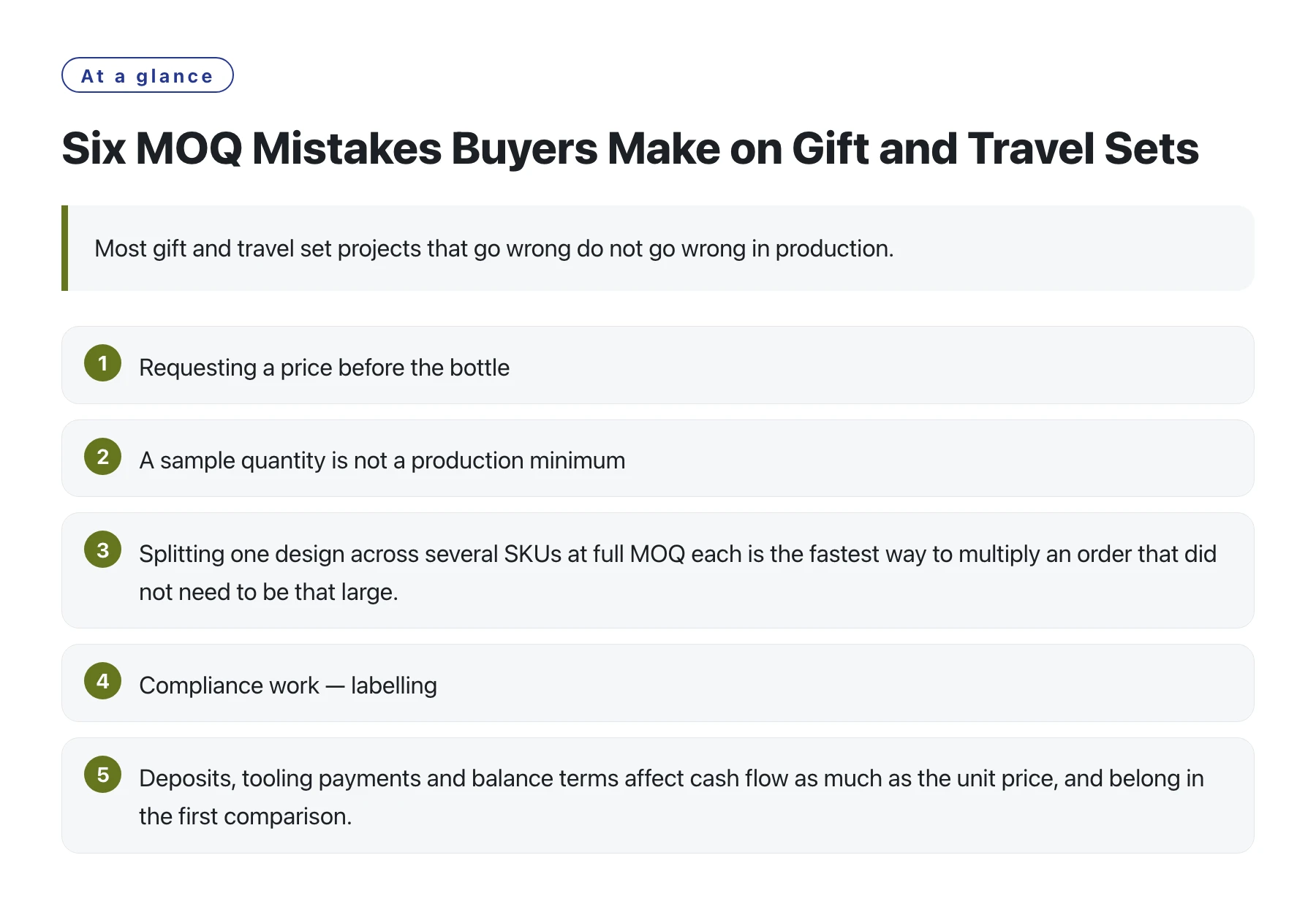
- Requesting a price before the bottle, decoration, box and concentrate are defined produces a number that will change.
- A sample quantity is not a production minimum; the smallest run a factory will schedule is usually far larger than the lab batch.
- Splitting one design across several SKUs at full MOQ each is the fastest way to multiply an order that did not need to be that large.
- Compliance work — labelling, testing and importer requirements — has its own lead time and should be scheduled, not assumed.
- Deposits, tooling payments and balance terms affect cash flow as much as the unit price, and belong in the first comparison.
Buyers who order gifts and travel sets repeatedly tend to develop the same instincts. They ask for the pack first and the price second. They find out which component is the constraint before they commit. They keep the first run deliberately plain.
Those instincts come from experience, and experience usually comes from one of the mistakes below. Knowing them in advance is cheaper.
The list is written from the buyer's side, but each item is really a gap in the brief that the factory then has to fill with an assumption.
Mistake one: asking for a price before the pack exists
A quotation is an output of a specification, not a substitute for one. When a buyer asks for the cost of a travel set without saying whether the bottle is stock or bespoke, whether the box is rigid or folding, and whether the logo is printed or stamped, the supplier has to guess. The guess is usually optimistic, because an optimistic number is the one that keeps the conversation alive.
The result is a price that moves upward through the project, which damages trust on both sides. A better first message names the components you are willing to standardise and the one or two you want to be distinctive.
Mistake two: reading a sample quantity as a production minimum
Sampling and production are different operations. A laboratory can compound a small trial batch, fill a handful of units by hand and send them out within days. A production line has to be scheduled, cleaned down afterwards and reconciled against a batch record, and that set-up is what the minimum order quantity actually pays for.
Buyers who approve a sample and then ask for the same quantity in production are usually met with a much larger number and interpret it as a sales tactic. It is not. The useful question is not how small the run can be, but what the smallest sensible run is given the components already chosen.
Mistake three: ordering every SKU at full MOQ
A gift set often contains several variants: three scents in the same bottle, or one scent in two formats. If each variant is treated as an independent order, each carries its own minimum. If the bottle, cap, carton and box are shared, the component minimums apply once and only the filling and the concentrate differ.
The same logic applies to concentrate. Building three fragrances from unrelated bases triples the perfumery minimum; building them from a shared accord with different top notes does not. The design decision and the MOQ decision are the same decision, which is why they should be discussed together rather than in sequence.
A quick test before you commit
List the components in the set and mark which ones change between variants. Everything that does not change should appear once in the order, not once per variant. If the supplier's quotation is structured per variant, ask for it to be restructured.
Mistake four: leaving compliance work until the end
Labelling, safety documentation and market notification are often treated as paperwork that happens after production. In practice they constrain the pack and the formula, so they belong at the brief stage. A label that must carry a full ingredient list, a batch code, a responsible person and a durability date is a design constraint, not a print job.
The market you are selling into decides how much of this there is. In the EU, a cosmetic product needs a responsible person established in the Union, and the product information file and labelling duties follow the product rather than the manufacturer's home market [1]. A gift set sold across several markets inherits the strictest applicable version of each requirement.
Testing is a separate workstream with its own queue. Stability, compatibility with the pack, and microbiological checks are typically run by third-party laboratories, whose published scope shows how many distinct tests a finished cosmetic can attract [2]. Scheduling those tests after the artwork is approved is a reliable way to miss a launch date.
Formula choices matter here too. Guidance on the safe use of fragrance materials sets concentration limits that vary by product type, so a brief built around a heavily restricted material narrows the palette available and can add work at the sample stage [3]. None of this is a reason to avoid a material; it is a reason to raise it early.
Mistake five: comparing unit prices instead of payment schedules
Two quotations with the same unit price can have very different cash-flow profiles. One asks for a deposit on order and the balance on shipment; another asks for tooling up front, a deposit at sampling and the balance before the goods leave. For a small brand, the timing matters more than the decimal places.
The place where cost hides is rarely the unit price itself. It is the tooling line, the artwork charge, the testing quotation and the freight, which is why where a perfume quote can hide costs is worth reading before the second round of negotiations rather than after. Ask for every line in writing, even the ones described as included.
Mistake six: going bespoke on everything in the first run
A distinctive bottle is a marketing asset and a tooling commitment at the same time. On a first order it also delays the project, because mould cutting sits on the critical path before filling can be scheduled. A travel set that looks considered can be built from stock glass, a standard pump, a printed label and a rigid box in a stocked format with a custom wrap.
The sensible division is to spend the differentiation budget where the customer actually looks and touches — the box, the print finish, the label typography — and keep the parts they cannot see standard until the volumes justify tooling. Brands that plan to license or expand the line later often find a factory for your own perfume label useful for this stage, because the same base pack can carry several labels without new tooling.
The counter-argument is real: a shared bottle makes the product harder to recognise on a shelf. That is a strategic choice worth making deliberately, with the tooling cost and the added lead time written down next to the benefit.
The pattern behind all six mistakes is the same: a decision made in the wrong order. Quantity before pack, production before sample, packaging before compliance, price before payment terms. Reordering those four conversations costs nothing and removes most of the surprises.
What a corrected brief looks like
A brief that avoids the mistakes above is not long. It names the market, the pack format, which parts are standard and which are not, the number of variants, the target quantity, and the documentation the importer will ask for. It states the retail price expectation so the supplier can say early whether the pack is realistic at that price.
It also asks for two quantities rather than one, so the buyer can see how the price behaves as volume rises. Buyers who send that brief get fewer revisions and a faster answer, because the supplier is quoting instead of interpreting. The the Xuelei website is one place where a manufacturer sets out its service scope in that level of detail, which makes it easier to see what a complete brief needs to cover before the first call.
Sources
- European Commission: Cosmetics in the EU —— The European Commission's overview of EU cosmetics rules, including the responsible person, product information file and safety report requirements.
- SGS: Cosmetics, Personal Care & Household Testing —— Testing, inspection and certification services for cosmetics and personal care, including microbiological, stability and safety testing aligned with cosmetics GMP.
- IFRA: Safe Use and Fragrance Science —— IFRA's explanation of how fragrance materials are scientifically assessed for safe use and how those conclusions are applied by the industry.
Frequently asked questions
How do I know if an MOQ is reasonable?
Ask which component produces it and what would change if that component were standardised. If the supplier can explain the floor in terms of a specific mould, die or batch minimum, the number is usually real. If the answer is vague, ask for it in writing.
Can I reduce the MOQ by supplying my own bottles?
Sometimes, but it moves risk to you. You take on the glass quality, the fit with the pump, the decoration and the freight, and the factory may still require a minimum filling run. It usually makes sense only when you already have a bottle you trust.
Is it cheaper to order one large run or two smaller ones?
One larger run is normally cheaper per unit, because set-up and tooling are spread further. Two smaller runs cost more but reduce the risk of holding unsold stock and let you correct a design decision. The right answer depends on how confident you are in the scent and the pack.
What should I never accept in a set quotation?
A single unit price with no component or cost lines, an MOQ with no explanation, and a tooling charge with no statement of who owns the tooling. Those three gaps cause most of the arguments that follow.
Do travel sizes have different rules from full-size bottles?
The rules follow the product and the market, not the size, although the label has to fit the smaller surface. What changes most with size is the pack: travel formats are more likely to use stock components, which is why they are often the easier place to start.