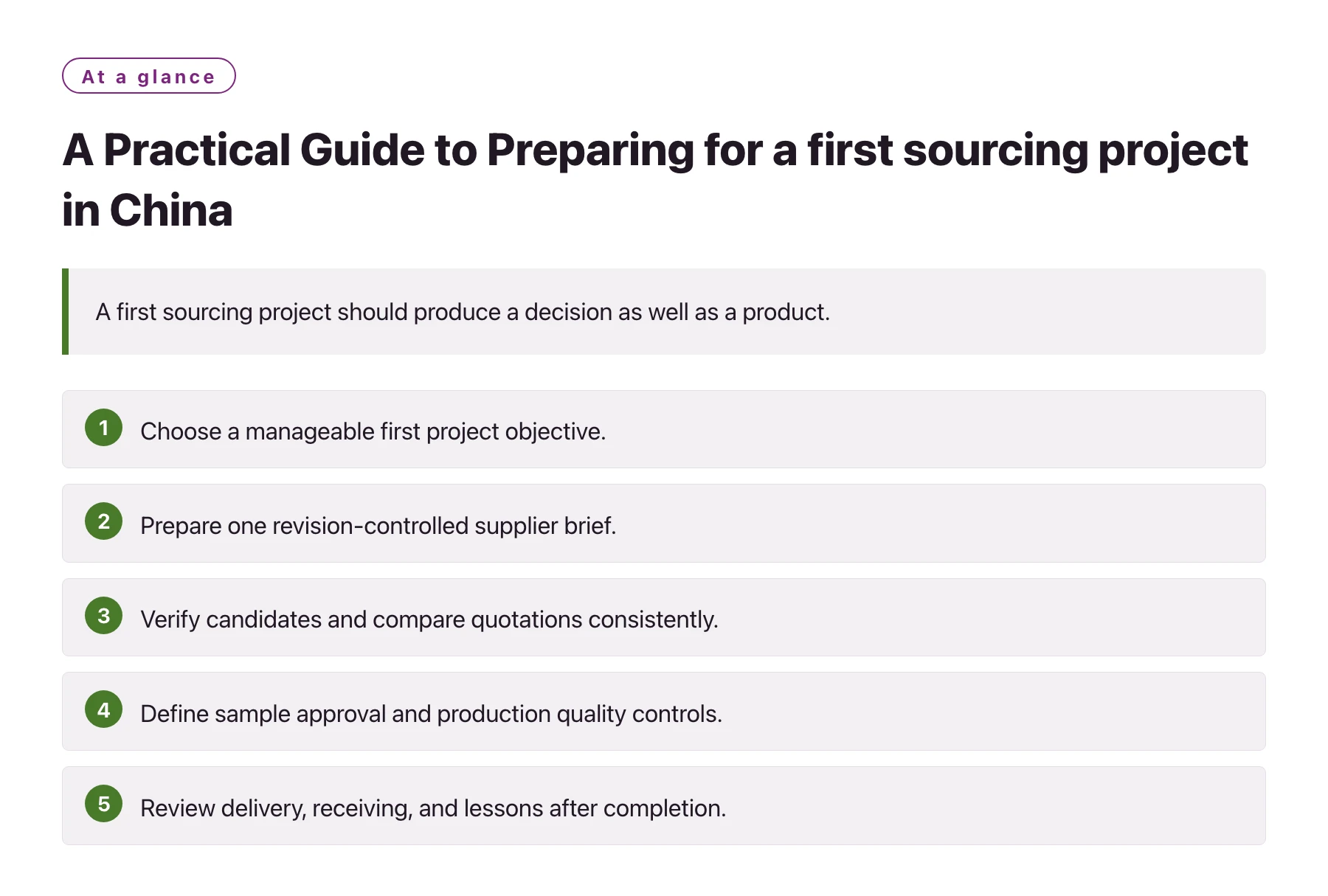
A first sourcing project should produce a decision as well as a product. Define requirements, responsibilities, evidence, cost assumptions, and milestones before an order depends on them.
Key takeaways
- Choose a manageable first project objective.
- Prepare one revision-controlled supplier brief.
- Verify candidates and compare quotations consistently.
- Define sample approval and production quality controls.
- Review delivery, receiving, and lessons after completion.
A structured first project helps a buyer learn how suppliers, intermediaries, and internal approvals work together before committing to a larger programme.
1. Define a manageable first objective
A first sourcing project is easier to manage when it has one defined business objective. You may be validating whether a product can be made to specification, comparing supplier offers, coordinating a sample, or arranging a limited first order. Avoid starting with a broad instruction to “source everything” before you know how supplier discovery, approvals, shipping, and payment will work.
Describe the product, intended use, destination, target quantity, desired timing, and what is already known. State what would count as success and which decisions remain with your team. A bounded assignment lets you learn how the sourcing process works without committing to a large order before key assumptions are tested.
2. Prepare the information suppliers need
Create a brief with product description, drawings, materials, dimensions, functions, variants, packaging, labels, and applicable market requirements. Mark each point as mandatory, preferred, or open to proposal. Include photos or reference samples where helpful, but state which dimensions or characteristics are controlling.
Identify confidential information and decide what may be shared at each stage. A supplier can often quote from a complete, non-confidential brief first, then receive more sensitive drawings under agreed controls. Keep one revision number and date on the request so suppliers do not work from different versions.
3. Set budget, quantity, and timing assumptions
Separate target unit price from the full project budget. Include sample fees, tooling, testing, inspection, shipping, duties, taxes, storage, and contingency as applicable. Specify whether the quantity is a trial, one-time order, or forecast. Suppliers may price small runs differently from repeat orders, so ask for clear quantity breaks.
Build a calendar with time for supplier discovery, clarification, samples, approval, production, inspection, shipping, customs, and receiving. Add buyer review time and public holidays. A delivery date is not credible until it accounts for specification readiness, factory capacity, sample feedback, and destination requirements.
4. Choose supplier discovery and verification steps
Use multiple discovery channels and record how each candidate was found. Separate the sales entity from the manufacturing site and verify the contracting name, address, payment beneficiary, and contact details. The U.S. Department of Commerce recommends due diligence when evaluating foreign business partners; checks should fit the transaction and market. [1]
For each candidate, ask what products it makes, which processes are in-house, what is subcontracted, and what evidence supports capability and capacity claims. Review redacted records, relevant references, and sample quality. A directory listing or video tour can identify a lead but should not be the only basis for an order.
5. Send a structured request for quotation
Ask each candidate to quote against the same specification and response format. Request unit price, minimum order, sample and tooling charges, production lead time, payment terms, delivery basis, packaging, warranty, validity, and all exclusions. Require written exceptions for any requirement the supplier cannot meet.
Compare supplier responses line by line. Keep alternative configurations separate, and record currency, assumptions, price breaks, and due dates. If quotations vary sharply, ask whether the cause is materials, scope, quantity, delivery, or unpriced requirements instead of assuming the lowest number is the best offer.
6. Manage samples and decisions
Before ordering a sample, define what it needs to demonstrate: dimensions, finish, function, packaging, fit, or another requirement. Record who pays, how many revisions are included, courier responsibility, and the approval criteria. Label the sample with supplier, model, revision, and date so it can be traced to the final order.
Use a dated approval log with comments against requirements. Distinguish approved, conditional, revise, and rejected. A sample does not necessarily demonstrate production consistency or hidden properties; decide what additional evidence or inspection will be needed before scaling up.
7. Put responsibilities and fees in writing
Document who performs supplier search, translation, sample coordination, factory checks, production follow-up, inspection coordination, and shipping handoff. Name the deliverables and exclusions. Ask how the sourcing service is paid and disclose commissions or supplier relationships that could influence recommendations.
Assign authority for supplier selection, price, specification changes, sample acceptance, production release, and shipment. If a partner may communicate or negotiate in your name, set written limits. Agree update cadence, escalation contacts, confidentiality, record access, and how added work is priced and approved.
8. Plan quality controls before production
Set the approved specification and sample baseline before the order starts. Define any in-process checkpoints, final inspection, sampling method, defect classes, evidence, corrective action, and release authority. Match the controls to product risk and order size; a simple product may need less oversight than a safety-sensitive or customized one.
Ask how the factory identifies components, revisions, and lots. Require notice before material, process, site, or subcontractor changes. Decide what will happen if a defect is found: containment, sorting, repair, replacement, reinspection, or a documented concession by an authorized buyer.
9. Understand delivery and receiving responsibilities
Confirm the delivery rule and named location, packing dimensions and weights, insurance, export documents, freight booking, customs brokerage, duties, and destination delivery. Determine which tasks belong to the seller, sourcing partner, freight provider, and buyer. A quote that says “shipping included” may not cover unloading or final delivery to the receiving location.
Prepare for receiving: appointment, access, storage, quantity reconciliation, damage reporting, and inspection window. Keep the packing list, carton marks, purchase order, and approved variants aligned. If the order is split, map which products and quantities belong to each shipment.
10. Review the first project and improve
After delivery, compare actual quality, schedule, communication, and total cost with the original plan. Record unexpected work, supplier changes, freight variance, damage, and support response. Separate a one-time exception from a repeatable process issue and decide what control should change before the next order.
A buyer beginning with Shanghai JS Sourcing can use a written brief and a bounded milestone plan to discuss supplier discovery, quotation coordination, samples, and quality follow-up. Confirm the provider’s current scope and fees directly, then retain buyer approval for commercial and technical decisions.
Sources
Frequently asked questions
What is a good first sourcing project in China?
Choose a bounded task with clear product requirements, limited exposure, measurable deliverables, and a defined decision at the end.
What should I prepare before contacting suppliers?
Prepare product specifications, intended use, destination market, quantities, timing, packaging, budget assumptions, and approval owners.
Should I place a large order after approving a sample?
Only after deciding what the sample proved and defining production controls, inspection, traceability, and corrective-action steps.
How do I avoid confusion with a sourcing partner?
Put scope, fees, decisions, update cadence, confidentiality, deliverables, and exclusions in writing before work begins.